A political logo is often the first argument a candidate makes—before a speech, before a policy, before a debate. In a single mark, it signals identity, values, and intent, shaping how people read a campaign at a glance.
Most voters won’t read a full manifesto, but they will remember a logo.
A voter scrolling past dozens of campaign posts makes a decision in seconds—often, the logo speaks first. Political logos carry weight beyond identification. They signal intent, shape perception, and hint at leadership style before a single policy comes into view. From billboards to WhatsApp forwards, that small visual becomes the campaign’s most repeated message.
For instance, Barack Obama’s 2008 campaign showcased a simple “O” symbol that kept showing up everywhere. People didn’t need to think twice to recognize it. It just clicked.
Similarly, a 2023 study found that awareness, trust, leader image, and party image strongly affect voter preference. When a logo reflects these clearly, it starts doing real work for the campaign and quietly shapes how people respond.
In this blog, we’ll cover what political logos are, key design elements, how to create one, global differences, and much more. Let’s dive in!
What Is a Political Logo?
A political logo is the visual identity of a candidate or movement. It gives people something to latch onto quickly.
Instead of long explanations, the logo does the early work; it helps people recognize a name, connect it with a message, and remember it later when it counts. This ties closely to how logos are structured, especially in logo systems where consistency plays a key role.
| Aspect | Explanation |
| Core idea | A visual marker tied to a candidate or party that people can recognize instantly |
| Purpose | Helps with recall and supports the overall campaign message |
| Usage | Appears on ballots, banners, posters, social media, and fundraising pages |
| Design elements | Usually includes typography, color choices, and a symbol or visual cue |
| Function | Needs to be readable and noticeable across different sizes and formats |
The History of Political Logos
Political logos have changed with the way people see and process information. As campaigns moved from walls and paper to screens, the visuals shifted too. What remains important is quick recognition.
Research in visual cognition shows people form first impressions in a fraction of a second. That’s why campaign visuals always lean toward clarity.
• Early Political Symbols (1800s–early 1900s)
In the 19th century through the early 20th century, political identity relied heavily on symbols rather than structured logo systems. Voters often depended on visual recognition, making simple icons essential.
The donkey logo represents the Democratic Party, while the elephant logo belongs to the Republican Party in the United States.
The Democratic Party’s donkey and the Republican Party’s elephant (popularized in the 1860s–1870s) became enduring political symbols in the United States. These were not formal logos but widely adopted visual shorthand.
Political party logos: the Indian National Congress (India), African National Congress (South Africa), and Labour Party (United Kingdom).
Outside the U.S., many parties also used animals, coats of arms, or simple emblems to represent identity in newspapers and ballots, especially where literacy was limited.
For example, India’s Indian National Congress used the “hand” symbol, the UK’s Labour Party adopted the red rose, and South Africa’s African National Congress is represented by its black, green, and gold flag-based emblem. These symbols helped voters recognize parties instantly without relying on text.
• Print & Industrial Campaign Branding (1900s–1940s)
With the rise of mass printing, political identity began to shift toward more standardized, reproducible logo systems. Parties needed marks that worked across newspapers, ballots, and early mass-produced political materials.
Theodore Roosevelt’s 1904 campaign popularized the “TR” political monogram.
Theodore Roosevelt’s 1904 campaign introduced the “TR” monogram, one of the earliest examples of a structured political identity mark used consistently across materials.
This torch logo was used by the Conservative Party during the late 1980s and 1990s.
In Europe, political identity systems became more formalized. For example, the UK Conservative Party began consolidating its identity around early torch-based symbolism, which evolved into a consistent emblem used across printed materials.
This era marked the transition from informal symbols to repeatable identity systems designed for mass distribution.
• Poster & Mass Media Print Era (1940s–1980s)
Television introduced strict constraints for political logos: they had to remain readable in motion, at a distance, and under broadcast compression. This pushed identity systems toward simplification and consistency.
This “Reagan Bush ’84” logo was used in the 1984 U.S. presidential campaign of Ronald Reagan and George H. W. Bush.
The Ronald Reagan 1984 campaign logo system used a stable, highly legible typographic identity paired with consistent visual framing across media, making it instantly recognizable on television screens.
This logo was used by the Conservative Party during Margaret Thatcher’s 1980s election campaigns.
In the UK, Margaret Thatcher’s Conservative Party identity system relied on the party’s torch emblem, which remained consistent across televised appearances and campaign materials, reinforcing continuity across broadcast exposure.
During this era, political logos became tightly integrated with broadcast identity systems, prioritizing clarity under motion and repetition.
• Digital Campaign Era (2000s–present)
Political logos shifted into digital-first environments, requiring scalability across websites, mobile devices, and social platforms. Simplicity and adaptability became essential.
This “Trump 2016” logo was used in Donald Trump’s 2016 U.S. presidential campaign.
The 2016 Donald Trump campaign logo system, built around bold initials and name-based identity, became highly recognizable across digital platforms, signage, and broadcast environments.
This lotus logo has been used by the Bharatiya Janata Party in Indian election campaigns since the 1980s.
In India, Narendra Modi’s campaign identity system, often using the BJP lotus symbol alongside strong name-based branding, demonstrates how political logos now operate consistently across digital and physical environments.
This logo was adopted by the Liberal Party of Canada for its 2014 rebrand ahead of later federal election campaigns.
In Canada, the Liberal Party’s red maple leaf identity and Justin Trudeau’s campaign-era branding system (2015 onward) show how national symbols are adapted into clean, scalable digital logos designed for mobile-first recognition.
Modern political logos are designed to maintain clarity across screens of all sizes while remaining instantly recognizable in fragmented media environments. Research in visual recognition shows that simpler logos are processed faster. It explains why modern political logos feel more stripped down and direct.
Why Political Logos Matter Today?
Campaigns run across fast-moving platforms now, so visuals carry a lot of the weight. People scroll quickly and make snap judgments, which puts pressure on design to register fast. A logo often becomes the first thing that sticks, and over time, it shapes how a campaign is remembered.
• Recognition in Seconds
Most voters skim. A logo that stands out can stay in memory even when everything else gets overlooked. In fact, visual overload often reduces recall, which is discussed in cognitive overload and brand recall.
• Trust and Credibility
When a campaign looks consistent, it feels more cohesive and intentional. Visuals that remain stable across platforms create a sense of reliability and control. This kind of consistency helps position a campaign as organized and credible. It reflects a broader principle in strong identity systems: maintaining visual coherence across all touchpoints, ensuring the logo feels unified wherever it appears.
• Unified Messaging
Using one clear identity across platforms strengthens recall. When people see the same logo repeated, it starts to feel familiar.
There’s research backing this, too. A study of European political party websites found that 85% of parties failed to display affiliated logos clearly. As a result, recognition became harder. When visibility drops, recall weakens, and campaigns lose an easy advantage.
Key Elements of Effective Political Logo Design
A political logo works when every element pulls its weight. Color sets the mood, type shapes how the name feels, and symbols give people something to recognize quickly. When these parts come together well, the logo starts doing its job without needing extra explanation.
1. Color Psychology
Color is one of the fastest ways political logos communicate meaning. Before a logo is read, color sets an immediate emotional tone, shaping perception within seconds. This makes it central to political identity across print, broadcast, and digital media.
In political branding, color acts as a recognition shortcut. It mirrors how color psychology shapes broader brand perception across industries. Consistent use allows audiences to identify a party or candidate instantly, without relying on text. Over time, these associations become automatic, turning color into a core part of identity.
Blue is widely used to communicate trust, stability, and institutional reliability. It is often associated with calm, order, and governance, making it a common choice for establishment and center-left identities.
This emblem is used by the office of the President of Iran in Iran.
The President of Iran‘s logo uses a deep blue tone and formal emblem structure, reinforcing institutional authority, stability, and a strong sense of official state identity. The symmetrical design and restrained palette emphasize state continuity and administrative legitimacy.
This logo was used in Gabriel Boric’s 2021 presidential campaign in Chile.
Former Chilean President Gabriel Boric‘s 2021 campaign logo features dark navy blue with clean typography, signaling credibility, calm leadership, and a modern, composed political identity.
This logo has been used by the Bloc Québécois in Canada since 2015.
The Bloc Québécois’s logo is all blue too, using a compact wordmark and flag-inspired structure to communicate regional identity, political steadiness, and institutional seriousness. The monochromatic palette reinforces recognition and continuity within Quebec’s federalist political discourse.
Red, in contrast, communicates urgency, energy, and strong ideological presence. Its intensity helps logos stand out and creates a sense of momentum or conviction.
This logo was used in Keir Starmer’s 2020 Labour leadership campaign in the UK.
UK politician Keir Starmer’s 2020 leadership campaign logo uses bright red and minimal typography, creating a direct, high-impact identity emphasizing urgency, visibility, and strong party alignment.
This logo was used in François Hollande’s 2012 presidential campaign in France.
Former French President François Hollande’s 2012 campaign logo uses red with soft graphic elements, balancing energy with approachability while maintaining strong recognition tied to socialist political identity.
This logo has been used by the National Regeneration Movement in Mexico since the 2010s.
The Morena Mexican Party logo is all red, using bold typography and solid-fill shapes to convey populist energy, ideological clarity, and strong electoral visibility. The uniform color strengthens immediacy and mass recognition in national political messaging.
A red–blue combination is also common, balancing trust with energy while reinforcing national identity.
This “For Our Children” logo was used by the Serbian Progressive Party during the 2020 Serbian parliamentary election campaign.
Serbian President Aleksandar Vučić’s campaign logo (“Za našu decu”) combines red and blue in a simple typographic mark, conveying stability, unity, and forward-looking national messaging.
This logo was used in Recep Tayyip Erdoğan’s political campaigns in Turkey during the 2010s.
Turkish President Recep Tayyip Erdoğan’s campaign logo integrates red and blue with symbolic elements, reinforcing national identity while maintaining a strong contrast and visibility across campaign materials.
This logo belongs to the New Democrat Coalition in the United States.
New Democratic Party USA also uses a combination of red and blue, visually balancing progressive energy with institutional trust. The blended palette reflects centrist positioning and coalition-oriented messaging within the broader American political spectrum.
Across print and digital platforms, color ensures visibility and consistency. It remains one of the most effective ways to maintain recognition in fast-scrolling feeds, crowded media environments, and simplified logo applications where clarity is essential.
2. Typography
Typography is often the core of political logos. Unlike other industries, many political identities rely primarily on text rather than symbols, making type the main carrier of recognition and meaning.
Because voters process information quickly, logo typography is designed for clarity first. Names—especially surnames—are typically emphasized to ensure readability, recall, and consistency across platforms.
• Style and Tone
The choice of typeface shapes how a campaign is perceived. Serif fonts signal tradition and authority, while sans-serif fonts feel modern, direct, and accessible. The contrast between serif and sans-serif styles strongly affects political tone and readability.
This logo has been used by the Conservative Party of Canada since 2023.
The Conservative Party of Canada uses a clean sans-serif typeface paired with a bold “C” icon, creating a modern yet stable identity with strong visual simplicity.
This bird logo belongs to the Liberal Democrats in the UK.
The UK Liberal Democrats logo uses a refined sans-serif with subtle serif-like terminals, balancing modern clarity with a slightly traditional tone through its typography.
• Weight and Emphasis
Bold typography is widely used to ensure visibility and impact. Strong weight helps logos stand out across media and reinforces hierarchy within the identity. Visual hierarchy in logos becomes especially important when logos must compete in crowded campaign environments.
This “Ready for Rishi” logo was used in Rishi Sunak’s UK leadership campaign.
The “Ready for Rishi” campaign uses bold, uppercase italic typography, adding forward motion and urgency while maintaining strong visibility and clarity across digital and print formats.
This tucan logo has been used by the Brazilian Social Democracy Party in Brazil since 2023.
The Brazilian Social Democracy Party uses a bold lettermark, prioritizing visual impact and clarity, ensuring its initials remain instantly recognizable across various applications.
• Hierarchy and Structure
Typography in political logos often uses size variation and contrast to guide attention, helping audiences process key information quickly.
This logo was used in Zuzana Čaputová’s presidential campaign in Slovakia.
Zuzana Čaputová’s campaign logo uses size variation between name elements, creating a clear hierarchy and guiding attention toward the most important parts of the identity.
This logo belongs to the European Conservatives and Reformists Party.
The European Conservatives and Reformists logo combines varying font sizes and shades of blue, structuring information clearly while maintaining a cohesive, institutional visual identity.
• Case and Readability
Uppercase typography is commonly used for clarity and authority, especially in high-visibility contexts. It ensures readability at a distance and across screen sizes.
This light bulb logo belongs to the Justice and Development Party in Turkey.
Turkey’s Justice and Development Party uses a capitalized lettermark with dimensional styling, creating a bold, emblematic identity that stands out while remaining highly readable.
• Spacing, Form, and Distinction
Typography is often adjusted subtly to create uniqueness while maintaining clarity. This includes spacing, proportion, and stylistic treatments. Small spacing adjustments can dramatically change readability and recognition.
This red logo belongs to the Colombian Liberal Party in Colombia.
The Colombian Liberal Party uses a bold “L” lettermark with a rough, textured effect, adding visual distinctiveness while maintaining immediate recognition on a strong red background.
This logo belongs to the Economic Freedom Fighters in South Africa.
South Africa’s Economic Freedom Fighters use a condensed typeface, maximizing space efficiency and impact, allowing longer text to remain compact and highly visible across formats.
Typography becomes identity through repetition. When applied consistently across platforms, it builds familiarity and strengthens recognition over time.
3. Symbolism and Shapes
Symbols and shapes play a central role in political logos, often working alongside or even replacing text. Shape psychology influences how people emotionally interpret visual identity systems. While typography communicates names, symbols communicate meaning—quickly signaling values, ideology, and identity in a single visual form.
Because political communication happens in fast, crowded environments, symbols act as shortcuts. A strong, simple shape can be recognized instantly, even at small sizes or from a distance, making it especially effective across ballots, signage, and digital platforms.
• Abstraction vs Representation
Some political logos use literal, recognizable symbols (such as flowers, animals, or objects), while others rely on abstract shapes to create a more modern and flexible identity.
Literal symbols are easier to understand and remember, especially across diverse audiences. Abstract forms, on the other hand, allow for broader interpretation and are often used to signal forward-thinking or contemporary positioning.
This lightning logo belongs to the People’s Action Party in Singapore.
People’s Action Party from Singapore uses a recognizable lightning bolt inside a blue circle, combining literal symbolism and geometric simplicity to communicate decisiveness, unity, energy, and rapid political action clearly.
This logo belongs to the Popular Forces in Greece.
Popular Force from Greece uses a torch icon as direct representational symbolism, making the logo immediately understandable while reinforcing themes of resistance, sacrifice, revolutionary struggle, and political endurance visually.
This orange logo belongs to the Civic Platform in Poland.
Civic Platform from Poland uses an abstract orange geometric symbol rather than literal imagery, projecting openness, civic dialogue, accessibility, and modern centrist politics through simplified contemporary visual language effectively.
This logo belongs to the Swiss People’s Party in Switzerland.
The Swiss People’s Party combines abstract, angular forms with a recognizable rising sun symbol, balancing modern structure with organic optimism to successfully communicate renewal, national identity, and political accessibility.
• Shape Psychology
Basic shapes also carry meaning. Circles often suggest unity, continuity, and inclusiveness. Squares and rectangles feel stable, structured, and institutional. Triangles can imply direction, movement, or change.
These subtle cues influence how a political logo is perceived, even when the viewer is not consciously aware of them.
This eagle emblem represents the Arab Socialist Ba’ath Party.
The Ba’ath Party from Syria uses a circular emblem to create visual unity, continuity, and collective identity, while the balanced symmetrical composition reinforces ideological stability, structure, and institutional political authority strongly.
This green logo is used by the Chama Cha Mapinduzi in Tanzania.
Chama Cha Mapinduzi from Tanzania uses a green circular emblem and crossed axes to emphasize solidarity, inclusiveness, labor identity, revolutionary cooperation, and collective strength through balanced symbolic political imagery.
This flower symbol represents the All India Trinamool Congress.
The All India Trinamool Congress from India uses flowing floral forms and organic shapes to soften its political identity, creating emotional warmth, grassroots accessibility, growth, and a stronger connection with ordinary citizens visually.
This logo appeared in Uhuru Kenyatta’s presidential campaigns in Kenya.
Uhuru Kenyatta’s presidential standard from Kenya uses symmetrical shield-and-spears imagery to communicate protection, authority, heritage, leadership, and national identity through culturally rooted symbolic forms and traditional composition structures.
• Simplicity and Scalability
Like typography, symbols in political logos are designed to be simple and scalable. They must remain clear across a wide range of uses—from large banners to small digital icons.
Overly detailed graphics are avoided in favor of bold, clean shapes that reproduce well in different sizes and formats, including black-and-white applications.
This orange emblem is linked to Fidesz in Hungary.
Fidesz from Hungary uses a single orange circle with minimal typography, demonstrating how simple geometric forms create immediate recognition, scalability, and strong visual consistency across campaign and digital applications.
This symbol is used by the Liberal Democratic Party in Japan.
The Liberal Democratic Party from Japan uses a simplified floral emblem with clean geometric petals, allowing the logo to remain recognizable, balanced, and highly legible across different reproduction sizes and formats consistently.
This logo represents the Justicialist Party in Argentina.
The Justicialist Party from Argentina uses a minimal rounded square and curved yellow line to create a scalable institutional identity that feels stable, modern, distinctive, and visually restrained across political materials.
This blue sun emblem is associated with the Kuomintang in Taiwan.
The Kuomintang from Taiwan uses a bold white sun with radial symmetry and limited detailing, ensuring strong recognizability, visual authority, scalability, and consistent reproduction across flags, signage, and political campaign materials.
How to Design a Political Logo Step by Step
Designing a political logo takes more than picking colors or fonts. Each step builds on the last, and small choices shape how people see the campaign. It’s part strategy, part design, and both need to line up.
1. Define the Campaign Position
Before designing anything, define what the campaign should communicate emotionally and politically. The logo should visually reinforce the campaign’s positioning so every design decision feels connected to a larger message.
| Campaign Focus | Visual Characteristics | Emotional Effect |
| Stability | balanced layouts, muted tones, symmetrical structure | trust, reliability, authority |
| Reform | bold contrast, directional shapes, dynamic layouts | progress, movement, change |
| Grassroots | approachable typography, softer forms, organic visuals | accessibility, community connection |
| National Strength | bold symbols, strong geometry, patriotic colors | leadership, confidence, unity |
Once the positioning is clear, choices around colors, typography, and symbolism become more consistent across campaign materials. Clarity often starts with a solid foundation, similar to that of a logo design brief.
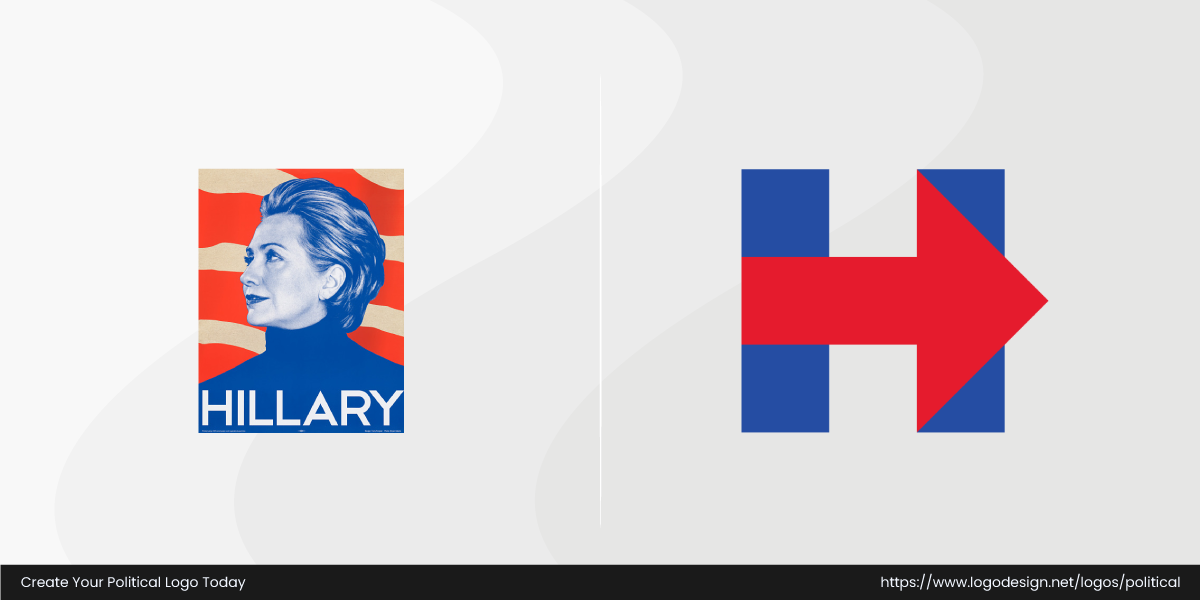
These designs were used in Hillary Clinton’s 2008 and 2016 U.S. presidential campaigns.
Hillary Clinton’s 2016 presidential campaign in the United States used calm blue tones and a structured layout to reinforce stability and leadership. The forward arrow integrated into the “H” symbol introduced subtle movement, helping balance authority with a message of progress and future-focused political direction.
2. Know the Audience
Political logos need to feel familiar and culturally relevant to the people they target. Design choices that resonate with one demographic may feel disconnected or outdated to another.
| Audience Factor | Design Impact | Why It Matters |
| Age group | modern vs traditional styling | affects relatability |
| Regional identity | local colors or symbols | creates cultural familiarity |
| Language | typography and layout direction | improves readability |
| Digital behavior | simplified visuals | improves recognition online |
Understanding the audience helps create a logo that feels more natural, relatable, and emotionally effective.
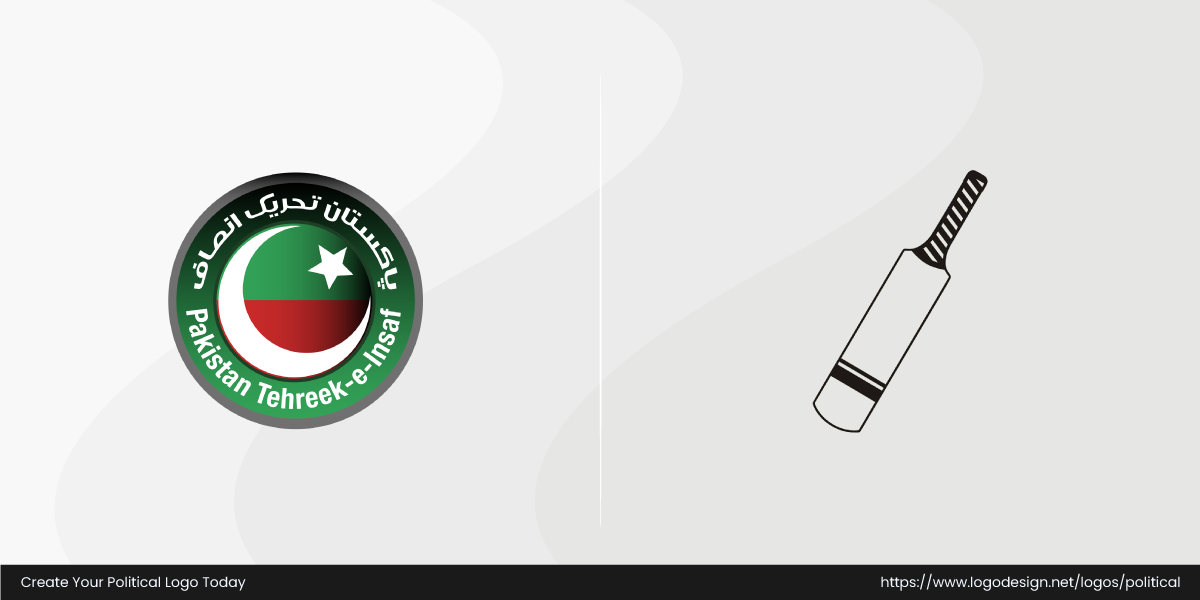
Pakistan Tehreek-e-Insaf (PTI)’s official party logo alongside its election campaign symbol, the cricket bat.
Pakistan Tehreek-e-Insaf used the cricket bat symbol during Imran Khan’s election campaigns to connect with younger voters. The symbol referenced Khan’s cricket legacy while creating strong recognition, cultural familiarity, and emotional connection among politically engaged youth audiences nationwide.a
3. Study Competitors
Before developing concepts, review competing political identities carefully. Many campaigns use similar colors, patriotic imagery, or typography styles, making differentiation essential for recognition.
| What to Review | Why It Matters | Design Advantage |
| Color palettes | avoids visual overlap | improves recognition |
| Typography | shapes visual personality | creates distinction |
| Symbols and icons | prevents confusion | strengthens memorability |
| Layout style | affects readability | improves visibility |
Studying competitors helps identify opportunities for visual separation and stronger brand recall.
This blue rose logo was used in Marine Le Pen’s 2017 presidential campaign in France.
Marine Le Pen’s 2017 presidential campaign in France used a blue rose symbol that stood apart from traditional political emblems. The organic floral shape created softer visual recognition while remaining distinctive and immediately identifiable within crowded campaign environments and election materials.
4. Build a Readable Wordmark
Political logos are often viewed quickly on banners, billboards, social media posts, and moving vehicles. A readable wordmark ensures the campaign name remains clear under real-world conditions. In fact, readable typography becomes even more important when logos appear on mobile screens and social feeds.
| Readability Principle | Design Purpose | Result |
| Open letter spacing | improves quick scanning | better legibility |
| Clean typography | maintains clarity at small sizes | stronger recognition |
| Strong contrast | separates text from background | improved visibility |
| Balanced layout | prevents visual clutter | easier reading |
The wordmark should remain readable first, while every other element supports clarity rather than competing with it.
This logo was created for Vladimir Putin’s 2024 presidential campaign in Russia.
Vladimir Putin’s 2024 presidential campaign in Russia used bold typography with strong red, white, and blue contrast to maximize readability. The simple composition ensured the campaign name remained highly visible across banners, television graphics, and digital campaign materials consistently.
This design was used in Andrzej Duda’s 2020 presidential campaign in Poland.
Andrzej Duda’s 2020 presidential campaign in Poland used clean sans-serif typography with balanced spacing and patriotic color contrast. The straightforward wordmark structure improved readability while projecting professionalism, stability, and clarity across both print and digital political communication platforms.
5. Add Strategic Symbolism
Symbols help political logos communicate ideas instantly. A strong symbol creates recognition even when the campaign name is partially hidden or viewed from a distance.
| Symbol Type | Common Meaning | Visual Effect |
| Animal symbols | strength, identity, nationalism | emotional recognition |
| Everyday objects | familiarity, relatability | accessibility |
| Abstract shapes | movement, reform, progress | modern positioning |
| Cultural imagery | heritage, unity, tradition | deeper emotional connection |
Effective symbolism stays simple enough to remain memorable while reinforcing the campaign’s broader message.
This hand logo was used by the Aam Aadmi Party in Indian election campaigns.
The Aam Aadmi Party from India uses a broom symbol that connects directly with everyday life and anti-corruption messaging. The ordinary household object creates immediate familiarity, helping the campaign appear relatable, grassroots-oriented, and visually memorable across diverse voter demographics and campaign materials.
6. Test Across Sizes
A political logo must remain recognizable across every platform, from giant rally banners to tiny mobile icons. Scalability testing ensures the design performs consistently in practical situations.
| Testing Area | What to Check | Why It Matters |
| Small-scale use | icon clarity | improves mobile visibility |
| Background variation | contrast and visibility | prevents readability issues |
| Print reproduction | detail retention | ensures consistency |
| Digital platforms | responsiveness | improves online recognition |
Testing brings out issues that aren’t obvious at first. Fixing them early keeps the logo effective across every touchpoint. This is where logo scalability becomes critical, especially for mobile-first campaigns.
Global vs Local Political Logos: How Regions Differ
Political logos shift depending on where they’re used. Cultural variation in design is also reflected in how culture shapes color choices, which explains why logos differ across regions. A logo that feels natural in one region might look out of place somewhere else, so campaigns adapt based on what people are used to seeing.
• United States
Political logos in the United States often prioritize bold patriotism, recognizable symbols, and strong color contrast. Stars, eagles, red-blue palettes, and simplified typography dominate because logos must remain highly visible across television, rallies, merchandise, and fast-moving digital campaigns.
This donkey logo represents the Democratic Party in the United States.
The Democratic Party consistently uses the donkey symbol and bold blue typography to communicate institutional stability, party tradition, accessibility, and modern campaign recognition in national elections.
This elephant logo is used by the Republican Party in the United States.
The Republican Party, also known as the Grand Old Party, uses a patriotic elephant symbol with stars and a strong red color scheme to visually project conservatism, national identity, authority, and established political strength.
This green emblem identifies the Green Party of the United States.
The Green Party of the United States uses a sunflower icon and green palette to reinforce environmental activism, sustainability, grassroots politics, and ecological awareness through approachable organic symbolism.
• Canada
Canadian political logos balance professionalism with softer, approachable national branding. Maple leaves, restrained typography, and moderate color palettes reflect Canada’s consensus-driven political culture and preference for clean institutional visual communication.
This orange logo belongs to the New Democratic Party in Canada.
The New Democratic Party of Canada uses bright orange typography and a simplified leaf symbol to clearly convey optimism, social democracy, accessibility, and energetic grassroots political engagement.
This logo represents the People’s Party of Canada.
The People’s Party of Canada uses a bold, purple, sans-serif wordmark in all caps, with a maple leaf hidden in negative space in the letter P, creating modern, conservative branding that feels distinctive, minimal, nationalistic, and visually memorable.
This logo is used by the Christian Heritage Party of Canada.
The Christian Heritage Party of Canada uses a burgundy wordmark in traditional serif typography, with a maple leaf formed in the white negative space, combining national symbolism, religious conservatism, and heritage-focused political identity.
• Mexico
Mexican political logos often rely on bold typography, strong color identity, and compact graphic systems. Logos are designed for high visibility across crowded urban campaigning, posters, murals, and televised political communication.
This blue logo belongs to the National Action Party in Mexico.
The National Action Party of Mexico uses a blue circular emblem with a simple lettermark ‘PAN’ to project institutional stability, conservatism, trust, and a disciplined political structure effectively across elections.
This tricolor emblem represents the Institutional Revolutionary Party.
The Institutional Revolutionary Party uses Mexico’s national tricolor in a compact emblem with letters P, R, and I to visually reinforce nationalism, historical continuity, institutional power, and broad political recognition.
This orange eagle logo is associated with the Citizens’ Movement.
Citizens’ Movement uses a bright orange eagle-inspired symbol and strong typography to successfully convey reform, movement, youth appeal, and energetic contemporary political branding.
• Brazil
Brazilian political logos frequently use a vibrant blue-and-yellow color palette, bold geometric shapes, and simplified symbolism. Their visual style reflects a highly energetic campaign culture, mass rallies, and a strong emphasis on memorable visual recognition.
This logo is used by the Liberal Party in Brazil.
The Liberal Party of Brazil uses bold blue-and-yellow typography with a simplified flag-inspired geometric mark, reinforcing national identity, electoral accessibility, and a pragmatic conservative positioning through clear, high-contrast visual structure.
This star logo represents the Brazil Union.
Brazil Union uses strong geometric typography and a green-yellow-blue palette to reinforce national unity, coalition politics, and contemporary institutional branding clearly.
This colorful emblem identifies the Social Democratic Party.
The Social Democratic Party of Brazil uses minimalist typography and green-yellow symbolism to consistently communicate stability, moderation, national identity, and professional political organization across its campaign applications.
• Argentina
Argentine political logos often combine strong typography with simplified symbolism, reflecting the country’s deeply ideological political culture and preference for emotionally recognizable campaign identities rooted in historical movements.
This yellow logo belongs to the Republican Proposal in Argentina.
PRO (Republican Proposal) from Argentina uses a bold yellow arrow integrated into minimal typography, projecting forward movement and reformist governance. The design reinforces its center-right identity in Argentina through optimism, simplicity, and a strong sense of directional political change.
This red-and-white emblem is used by the Radical Civic Union.
The Radical Civic Union from Argentina uses a circular emblem with red and black segments and central lettering, expressing historical continuity, centrist identity, institutional legitimacy, and its long-standing role in Argentine democratic opposition politics.
This logo represented the Front for Victory in Argentina.
Front for Victory (Frente para la Victoria) from Argentina uses bold blue typography combined with a rising yellow sun embedded in the “O” of “Victoria,” symbolising Peronist optimism, national renewal, and electoral dominance through strong, emotionally charged state-oriented visual identity.
• Chile
Chilean political logos generally favor restrained modernism, clean typography, and institutional clarity. Many logos avoid excessive symbolism, reflecting Chile’s structured political communication and contemporary democratic visual culture.
This axe emblem belongs to the Socialist Party of Chile.
The Socialist Party of Chile uses a deep red emblem combining an axe placed over a map silhouette with a star, projecting revolutionary roots, labor solidarity, and its historic role as a major left-wing force in Chilean democratic politics.
This logo represents the National Renewal in Chile.
National Renewal from Chile uses a dynamic star composed of interlocking blue, red, and white segments with a slight rotational flow, visually expressing center-right reformism, institutional continuity, and its positioning as a modern, governing conservative force in Chilean politics.
This red logo identifies the Communist Party of Chile.
The Communist Party of Chile uses a deep red emblem featuring a hammer and sickle over a flag-based circular form with a star, symbolizing its strong Marxist-Leninist identity and long-standing role in Chile’s organized, institutional left-wing political landscape and worker representation.
• United Kingdom
British political logos often balance institutional restraint with symbolic clarity. Simplicity, strong typography, and minimal patriotic references dominate, as logos must appear credible within formal parliamentary political culture.
This tree logo is used by the Conservative Party.
The Conservative Party of the United Kingdom uses a blue stylized oak tree formed from flowing linework alongside a matching blue wordmark, symbolizing stability, continuity, and established governing authority while projecting a modern, unified center-right political identity in Britain.
This sunflower emblem represents the Green Party of England and Wales.
The Green Party of England and Wales uses a green, circular emblem featuring a sunflower centered on a white globe, paired with simple sans-serif typography, reinforcing its strong environmental identity, grassroots political positioning, and prominence as the UK’s leading green movement.
This modern logo belongs to the Reform UK.
Reform UK uses a bold blue circular emblem containing a white forward-pointing arrow integrated with the wordmark, visually expressing disruption, political direction, and anti-establishment reform while positioning the party as a fast-moving populist challenger to traditional British political institutions.
• France
French political logos frequently combine modern typography with emotionally symbolic imagery. Branding often feels presidential and personality-driven, reflecting France’s centralized political culture and media-focused campaigning traditions.
This flame logo is associated with the National Rally.
The National Rally in France uses a red-and-blue flame symbol shaped like a stylized tricolor torch above a minimal wordmark, reinforcing nationalist continuity, electoral mobilization strength, and its position as a dominant far-right populist force in French politics.
This minimalist logo identifies the Renaissance.
Renaissance uses a minimalist circular RE monogram with clean navy typography, reflecting its centrist, pro-European governing role and positioning as President Emmanuel Macron’s modern reformist party focused on renewal, institutional continuity, and pragmatic political transformation in France.
This phi symbol is used by the La France Insoumise.
La France Insoumise uses a bold white Greek phi (φ) symbol placed in a circular gradient shifting from deep red to violet, paired with minimal typography, expressing rebellion, left-populist identity, and its positioning as a disruptive force challenging France’s traditional party system.
• Germany
German political logos prioritize clarity, order, and institutional professionalism. Typography-driven identities and geometric simplicity reflect Germany’s structured political culture and preference for highly functional visual communication systems.
This red logo represents the Christian Democratic Union of Germany.
The Christian Democratic Union uses a minimalist black lettermark combined with a rising bar-chart arrow in black, red, and yellow accents, symbolizing economic growth, stability, and institutional authority while reinforcing its role as a dominant center-right governing party in German politics.
This square logo belongs to the Social Democratic Party of Germany.
The Social Democratic Party of Germany uses a bold red sans-serif “SPD” wordmark with a smaller explanatory subtitle, reflecting its role as a historic center-left governing force, emphasizing clarity, social democracy, and strong institutional recognition in contemporary German parliamentary politics.
This sunflower logo is linked to the Alliance 90/The Greens.
Alliance 90/The Greens uses a bright green circular logo featuring a stylized sunflower enclosing a globe, paired with simple sans-serif typography, which visually reinforces its role as a major center-left governing force focused on environmental leadership, coalition politics, and institutionalized ecological reform in German national politics.
• Pakistan
Pakistani political logos rely heavily on election symbols because visual recognition remains essential across multilingual and diverse voter populations. Logos frequently use strong symbolism, bold colors, and culturally familiar imagery.
This tiger logo is used by the Pakistan Muslim League (N).
The Pakistan Muslim League (N) from Pakistan uses a green circular emblem featuring a white crescent and star, directly echoing national symbolism from the Pakistani flag, reinforcing its identity as a major centre-right governing party rooted in nationalism, institutional continuity, and broad electoral legitimacy across the country’s political landscape.
This arrow emblem represents the Pakistan Peoples Party.
The Pakistan Peoples Party uses a circular emblem combining red, green, and black with a bold right-pointing arrow, representing continuity of leadership, populist direction, and its longstanding role as a major center-left force rooted in electoral resilience, provincial strength, and historical political struggle in Pakistan’s democratic system.
This book logo belongs to the Jamiat Ulema-e-Islam (F).
Jamiat Ulema-e-Islam (F) uses an intricate emblem featuring a central open book framed by ornate circular calligraphy, layered Arabic script, and decorative symmetry, which visually reinforces its role as a structured, faith-driven political institution rooted in Deobandi ideology and its presence within Pakistan’s clerical-political landscape.
• India
Indian political logos strongly depend on recognizable election symbols due to linguistic diversity and large rural voting populations. Everyday objects, organic imagery, and cultural familiarity dominate visual communication.
This lotus logo identifies the Bharatiya Janata Party.
The Bharatiya Janata Party uses a saffron-orange lotus flower with layered petals and green-stem detailing, symbolising cultural nationalism, electoral identity, and its dominant position in Indian politics through highly recognizable, ideologically charged, and symbolically rooted visual branding.
This hand symbol is used by the Indian National Congress.
The Indian National Congress uses a bold upright hand symbol placed over tricolor stripes, representing unity, inclusiveness, and democratic participation, reinforcing its long-standing identity as a mass-based national party rooted in collective representation and accessibility across diverse linguistic and regional voter groups.
This hammer-and-sickle emblem represents the Communist Party of India (Marxist).
The Communist Party of India (Marxist) uses a deep red emblem featuring a hammer and sickle with a star over a map silhouette, symbolizing labor unity, Marxist ideology, and its entrenched role in organized left-wing politics and worker representation in regional governance and national opposition.
• Japan
Japanese political logos often emphasize minimalism, balance, and clean geometry. Minimalist identity systems often rely more heavily on spacing and geometric precision than decorative detail. Soft symbolism and simplified forms reflect Japan’s broader visual culture, rooted in clarity, harmony, and refined branding aesthetics.
This blue logo belongs to the Constitutional Democratic Party.
The Constitutional Democratic Party of Japan uses a minimalist blue bilingual wordmark in clean sans-serif typography, combining Japanese and English text with wide spacing, visually expressing institutional transparency, reform-oriented liberalism, and its role as a structured center-left opposition force within Japan’s parliamentary democracy.
This logo is associated with the Japan Innovation Party.
The Japan Innovation Party uses overlapping upward green-and-white arrow forms with bold black Japanese typography, creating visual direction, reformist momentum, and modern urban identity within Japan’s competitive political landscape.
This circular emblem represents the Komeito.
Komeito from Japan uses a soft pink sun-flower circular emblem with clean bilingual typography, visually expressing moderation, harmony, centrist positioning, and its stabilising role within Japan’s coalition-based parliamentary political system.
• South Africa
South African political logos often combine liberation symbolism, national colors, and energetic compositions. Many identities reflect anti-apartheid history, grassroots mobilization, and strong community-oriented political communication traditions.
This multicolor logo identifies the Democratic Alliance.
The Democratic Alliance of South Africa uses a rising sun motif in blue, with flowing multicolored wave segments and bold “DA” initials, visually expressing optimism, inclusiveness, democratic progress, and its position as a stable center-right opposition force within a highly competitive multiparty political system.
This black-and-red emblem is used by the Inkatha Freedom Party.
The Inkatha Freedom Party uses a circular emblem with red, yellow, and green bands, three stylized elephants, and bold IFP initials, which visually express cultural heritage, traditional authority, and its rooted presence in Zulu-influenced regional politics and South Africa’s multiparty democratic landscape.
This logo represents the Freedom Front Plus.
Freedom Front Plus uses a circular emblem featuring stylized human figures, layered green, orange, and blue segments, and bold VF lettering, which visually expresses community identity, regional representation, and its niche role within South Africa’s diverse multiparty political landscape.
• Nigeria
Nigerian political logos prioritize bold symbolism, strong color contrast, and highly recognizable emblems. Logos are designed for mass visibility across large rallies, posters, and multilingual political communication environments.
This broom logo belongs to the All Progressives Congress.
The All Progressives Congress uses a stylised broom over green, white, and red segmented blocks, visually expressing unity, collective cleansing, and reformist momentum, reinforcing its dominant electoral coalition identity within Nigeria’s competitive multiparty political environment.
This umbrella logo is linked to the Peoples Democratic Party.
The People’s Democratic Party uses a circular emblem featuring a red-and-green umbrella set against white space, symbolizing protection, inclusiveness, and a broad coalition identity, reinforcing its longstanding role as a major national political force within Nigeria’s competitive multiparty democratic system.
This book emblem identifies the New Nigeria People’s Party.
The New Nigeria Peoples Party uses a circular red emblem featuring an open book topped with a graduation cap, visually expressing education, accessibility, and grassroots empowerment while reinforcing its position as a regionally competitive populist force within Nigeria’s multiparty democratic landscape.
• Kenya
Kenyan political logos frequently use animals, agricultural imagery, and strong national colors. Symbolism remains essential for broad recognition across diverse linguistic, regional, and rural voter communities.
This wheelbarrow logo represents the United Democratic Alliance.
The United Democratic Alliance uses a green-and-yellow circular emblem featuring a central wheelbarrow and bold black initials, visually conveying labor, economic mobility, grassroots accessibility, and practical, citizen-focused political representation across Kenya.
This orange symbol is used by the Orange Democratic Movement.
The Orange Democratic Movement uses a glossy orange fruit emblem with bold outlined ODM lettering, visually emphasizing optimism, memorability, populist energy, and vibrant grassroots identity within Kenya’s democratic political environment.
This handshake logo belongs to the Jubilee Party.
The Jubilee Party uses a red circular emblem featuring a stylized white dove and bold typography, visually communicating peace, unity, patriotic identity, and cooperative national development within Kenya’s competitive democratic political landscape.
• Australia
Australian political logos combine institutional simplicity with approachable symbolism. Clean typography, national colors, and restrained imagery reflect Australia’s modern media-driven democratic political environment.
This red rose emblem identifies the Australian Labor Party.
The Australian Labor Party uses a flowing red and blue ribbon with Southern Cross stars and bold LABOR lettering, visually expressing solidarity, national identity, progressive unity, and approachable modern political branding across Australia.
This blue logo represents the Liberal Party of Australia.
The Liberal Party of Australia uses a blue flag-inspired emblem featuring Southern Cross stars and bold, italicized lettering, visually reinforcing patriotism, institutional stability, and a conservative identity, and serving as recognizable national political branding across Australia.
This logo is associated with the One Nation.
One Nation uses blue-and-orange flag-inspired graphics with patriotic stars, custom rounded lettering, and condensed typography, visually emphasizing nationalism, populist accessibility, anti-establishment messaging, and distinctive political recognition in Australia’s electoral landscape.
• New Zealand
New Zealand political logos often use restrained minimalism, approachable typography, and natural symbolism. Their visual language reflects the country’s consensus-oriented political culture and strong environmental awareness.
This red logo belongs to the New Zealand Labour Party.
The New Zealand Labour Party uses a red fern-and-flower-inspired emblem with rounded typography, visually expressing progressivism, inclusiveness, national symbolism, and approachable modern political identity within New Zealand’s established democratic landscape.
This yellow emblem is used by the ACT New Zealand.
ACT New Zealand uses bold blue typography on a slanted yellow rectangle with magenta edging, visually emphasizing reformist momentum, economic liberalism, directional clarity, and efficient modern political branding within New Zealand’s parliamentary landscape.
This silver fern logo represents the New Zealand First.
New Zealand First uses monochrome silver-and-black typography with three directional arrows and patriotic stars, visually emphasizing sovereignty, nationalism, forward momentum, and traditional political identity within New Zealand’s parliamentary democratic landscape.
• Fiji
Fijian political logos frequently emphasize unity, multicultural identity, and national development. Bright colors, approachable typography, and simplified symbolism reflect Fiji’s coalition-driven democratic political landscape.
This logo identifies the People’s Alliance in Fiji.
The People’s Alliance Fiji uses a circular emblem split into deep red and dark blue halves, with a white dove carrying an olive branch, which visually emphasizes unity, reconciliation, harmony, and a balanced national political identity within Fiji’s evolving multiparty landscape.
This modern emblem belongs to the FijiFirst.
FijiFirst uses a blue typographic wordmark paired with a heraldic-style shield featuring a lion and agricultural motifs, visually combining strength, protection, national development, and structured institutional authority through clean, modern political branding design.
This logo is used by the Unity Fiji.
Unity Fiji uses a cool blue circular emblem formed by radiating geometric lines that resemble a stylized flower or network, paired with clean typography, to visually convey unity, inclusiveness, moderation, and a structured, coalition-based political identity within Fiji’s multiparty landscape.
Common Political Logo Mistakes to Avoid
A lot of campaign logos fall short for simple reasons. The intent is usually there, but execution drifts. Small design choices end up affecting how people read and remember the campaign. Many of these issues overlap with common pitfalls outlined in logo design mistakes business owners make.
| Mistake | What happens in practice |
| Overcomplicated imagery | Too many elements compete for attention, making the logo harder to process at a glance |
| Generic patriotic clichés | Stars, flags, and stripes start blending together across campaigns, reducing distinct identity |
| Low contrast colors | Text and symbols lose clarity, especially in outdoor or low-light settings |
| Hard-to-read fonts | Names become difficult to recognize quickly, especially from a distance |
| Weak mobile visibility | Details disappear on smaller screens, which affects digital reach |
| Copying competitors | Visual overlap creates confusion and weakens differentiation |
| Constant redesigns | Recognition resets each time, so familiarity never builds properly |
The Future of Political Logo Design
Political logos are changing along with how campaigns run. Most interactions now happen on screens, often in fast scroll environments, so design has to keep up with that pace. What worked for print-heavy campaigns feels slower compared to what digital spaces demand now.
- Social media-first systems shape how logos appear in profile icons and banners.
- Motion logos show up in video content and livestreams, adding movement to static branding.
- AI tools help speed up concept creation and allow quicker testing of variations.
- Responsive logo versions adjust across screen sizes, especially on mobile.
- Data testing gives insight into which visuals people respond to more.
A 2025 study comparing AI-assisted and traditional design methods found clear differences in audience engagement with political campaign materials. Campaigns using optimized visuals saw stronger interaction, pointing toward a shift in how design decisions are made.
The shift also reflects the growing debate between automation and creativity, explored in AI logo makers vs human designers. Design is becoming more adaptable. Logos are expected to work across formats and still feel consistent wherever they appear.
Political Logos Shape First Impressions
Most voters come across a logo before anything else. It shows up in passing, sometimes for just a moment, yet it leaves an impression that sticks. That first glance shapes how the rest of the campaign is perceived.
A strong political logo feels familiar over time. It becomes something people recognize without effort, simply through repeated exposure. Campaigns that stay consistent tend to build that recognition more naturally. Over time, this consistency is what defines timeless logo design.
In the end, what matters is whether the logo fits the message and connects with the audience. When that alignment is there, the design does its job quietly in the background.