From A to Z, letters can speak volumes. Alphabet logos are sleek and simple, yet tricky—here’s when they shine and when they stumble.
Have you ever noticed how some logos say everything without saying much at all? Just a single letter, a pair of initials, and somehow the brand sticks. Think about how quickly names like IBM or HP come to mind, even though their logos keep things stripped back. There’s a quiet confidence in that kind of simplicity.
However, the tricky part here is that what works brilliantly for one brand can flop spectacularly for another. A single initial can feel iconic or utterly forgettable, depending on context, design, and recognition. That thin line between striking and bland is what makes alphabet logos fascinating. They promise simplicity and memorability, yet demand careful thought to avoid fading into the background.
Got Initials Worth Showing Off?
Turn them into a sharp, distinctive alphabet logo that people recognize at a glance.
In this blog, we’ll highlight the appeal of the alphabet logos, such as why they work so well, as well as when it’s best not to use them.
What Exactly Is an Alphabet Logo?
Alphabet logos are all about using letters to represent a brand instead of relying on full words, symbols, or illustrations. They strip a company’s identity down to its essence—sometimes just a single letter, sometimes a pair of initials. The goal is simplicity, memorability, and instant recognition.
There are two main types: lettermarks and monograms. Lettermarks usually use the initials of a company’s name.
Take IBM, for example, which stands for International Business Machines. The logo is just the three letters, but it carries decades of recognition and authority, making the full name almost unnecessary.
Stylized single-letter logos take one letter and turn it into an iconic symbol. Think of McDonald’s with its golden “M.” It’s simple, memorable, and instantly recognizable.
Often, alphabet logos evolve from longer names. A business may start with a full name to establish itself, then distill it into initials or a single letter once recognition grows. This approach keeps the identity clean and versatile while maintaining a connection to the brand’s origins.
The Anatomy of a Strong Alphabet Logo
A great alphabet logo is a careful combination of design choices that make it memorable, readable, and versatile.
Every element plays a role in how the logo communicates your brand at a glance.
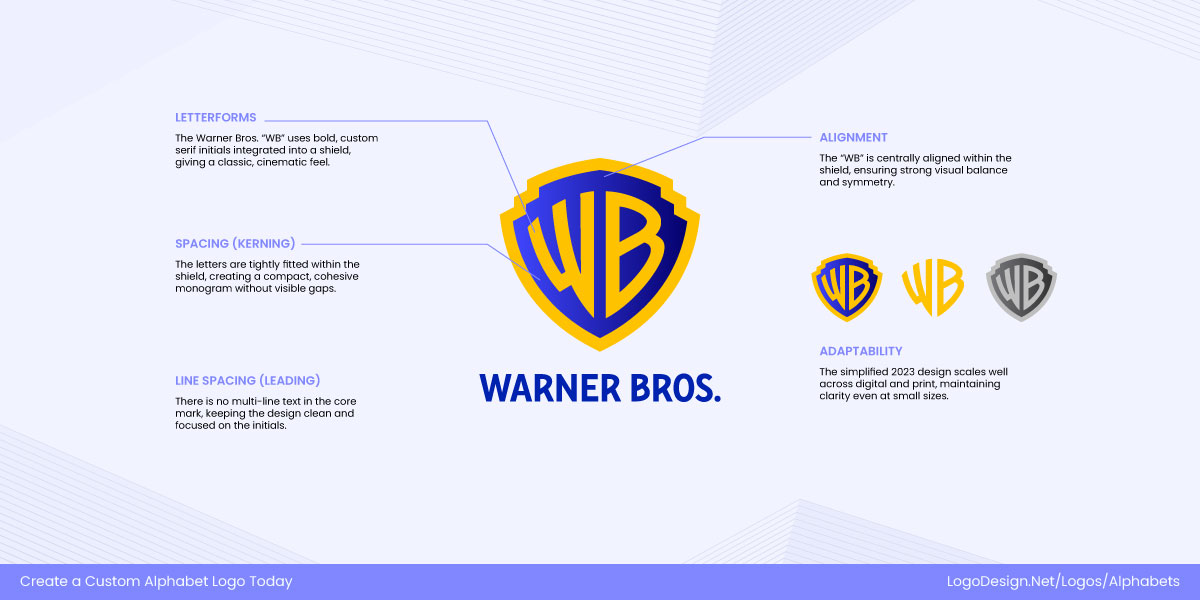
1. Letterforms
The shape and style of each letter define the logo’s personality. Custom letterforms or subtle ligatures can make the logo unique, while standard fonts may feel generic. How letters interact with each other also affects flow and balance.
2. Spacing (Kerning)
The distance between letters, known as kerning, is the hidden hero of logo typography—it affects readability and cohesion. Proper spacing ensures each letter stands out while the overall wordmark feels harmonious. Tight or uneven spacing can make a logo feel cramped or awkward.
3. Line Spacing (Leading)
If your lettermark includes a tagline or secondary text, line spacing is critical. Proper leading keeps the text readable and balanced with the main initials, ensuring nothing feels squeezed or lost.
4. Alignment
Alignment influences visual stability. Centered, left, right, or justified positioning can change how the logo feels on different surfaces. Balanced alignment makes the logo look intentional and professional, while poor alignment can feel chaotic.
5. Adaptability
A strong alphabet logo works everywhere—from tiny app icons to giant billboards. It should retain clarity and impact across sizes, colors, and platforms, without losing its identity or becoming distorted.
Make Your Initials Do the Talking
Ready to build a logo that says more with less? Start today!
Why Alphabet Logos Work So Well
Alphabet logos are simple, versatile, and memorable, which is why many successful brands rely on them. Their adaptability allows brands to maintain consistency across digital and physical platforms. A single well-crafted letter or initial can communicate trust, prestige, and style—all while leaving room for the brand to grow over time.
Many companies have long or difficult-to-remember names, and alphabet logos condense them into a clean, instantly recognizable mark.
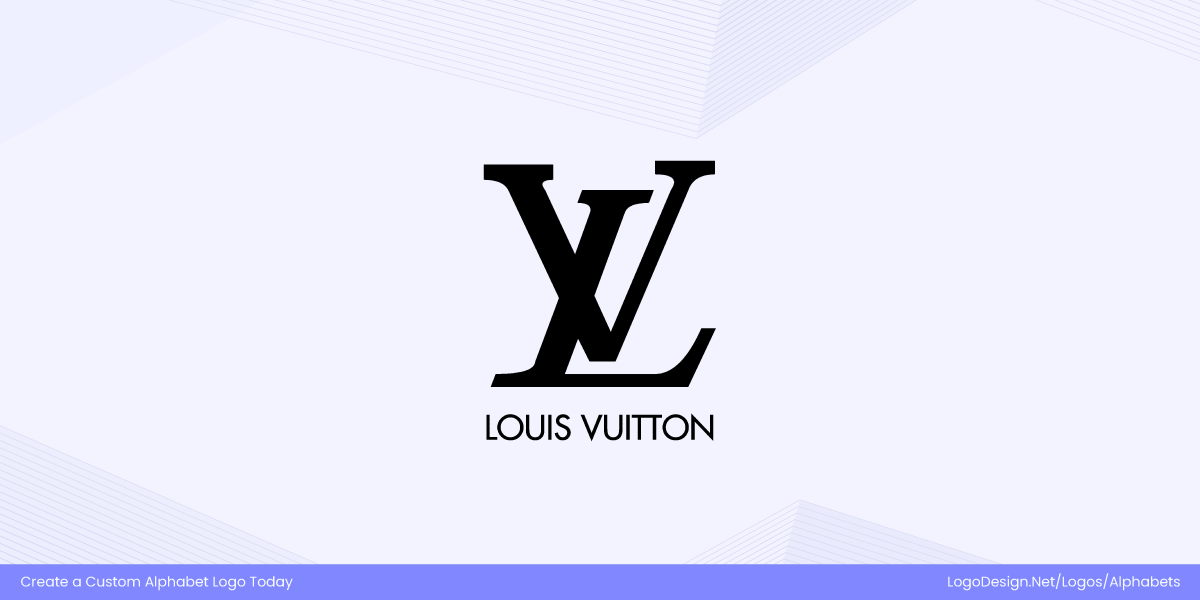
For instance, Louis Vuitton’s iconic “LV” transforms the full name into a compact, elegant symbol that works across bags, clothing, and advertising.
Similarly, General Electric relies on the circular “GE” monogram, which fits seamlessly on products ranging from light bulbs to jet engines.
By focusing on letters, brands streamline their identity, making it easier for audiences to remember and connect with them. Alphabet logos also reduce space constraints on packaging and digital screens, giving brands flexibility while maintaining elegance. The simplicity of letters can convey authority and sophistication, allowing the logo to do heavy lifting without additional visuals.
In a digital-first world, logos must perform well at every size and medium. Alphabet logos excel because letters scale naturally and remain legible, whether they appear on a tiny app icon or a massive billboard.
Pinterest’s distinctive “P” logo is instantly recognizable across its website, app, and printed merchandise.
Tesla’s sleek “T” logo works equally well on car grills, charging stations, and online campaigns, providing consistency while reinforcing the brand identity.
The adaptability of letter-based logos also reduces the risk of distortion or confusion when resized. Because the design is focused and uncluttered, it maintains clarity even in monochrome or minimalistic versions, ensuring the logo is effective in a wide range of visual contexts.
Lettermarks and initials often communicate credibility, trust, and prestige, which is why established brands lean on them.
The BBC uses its three-letter mark to signal reliability and authority, familiar to audiences worldwide immediately.
Klynveld Peat Marwick Geordeler KPMG’s initials convey professionalism and global presence, crucial in the corporate world.
Alphabet logos create a sense of permanence and confidence that abstract symbols may not achieve as effectively. The minimalism of letters suggests that a brand doesn’t need embellishment to prove itself—it’s confident enough to stand on its own. This perception of authority helps brands build credibility quickly, which is particularly valuable for businesses in finance, media, law, or consulting, where trust is a major differentiator.
Unlike logos tied to a specific product or image, lettermarks give brands the flexibility to evolve without redesigning their identity.
Yves Saint Laurent (YSL) uses the intertwined letters to convey elegance and style across clothing, accessories, and marketing campaigns.
Similarly, LG uses “L” and “G” in a friendly, circular design. It carries meaning beyond the initials and adapts to product lines from phones to home appliances.
Alphabet logos allow for reinterpretation as the brand expands, helping companies stay relevant without losing recognition. This flexibility makes lettermarks ideal for growing brands, as they can maintain consistency while experimenting with visuals, product ranges, or even markets—something more literal or illustrative logos often struggle to do.
One of the strongest advantages of alphabet logos is how easily they stick in memory. When a brand reduces its identity to a single letter, it creates a visual shortcut that people can recall without effort. So, instead of processing a full name, the brain only needs to recognize one distinct shape.
Netflix uses its bold red “N” as a quick identifier across its app and marketing, allowing users to recognize it instantly even in crowded interfaces.
Similarly, Beats Electronics relies on its lowercase “b,” which doubles as a headphone icon, reinforcing both the name and the product category.
This kind of visual shorthand makes brands easier to remember over time, especially in fast-scrolling digital environments where attention spans are limited.
Where Do Alphabet Logos Fall Short?
For all their strengths, alphabet logos are not a perfect fit for every brand. Their simplicity can sometimes work against them, especially when there is little brand recognition to support them. Without the right design and context, a single letter can feel vague, generic, or easy to overlook.
A single letter rarely tells a story on its own. Unlike a symbol that hints at a product or idea, an initial depends on the audience already knowing what it stands for. This is where brands like Apple have an advantage. The bitten apple instantly suggests something distinctive, even to someone unfamiliar with the brand.
In contrast, a standalone letter does not carry that same built-in meaning. It needs consistent exposure, messaging, and visual support to gain significance over time. Without that foundation, the logo can feel empty rather than minimal.
There is only a limited number of letters, and many businesses end up sharing the same initials. Without careful design, alphabet logos can start to look interchangeable, especially in crowded industries. This is where distinct execution becomes important.
H&M, for example, uses bold, hand-drawn lettering that feels energetic and unmistakable, helping it stand apart from other two-letter brands. Poorly designed lettermarks, on the other hand, often rely on basic fonts with little personality, making them easy to ignore or confuse with competitors. When originality is missing, simplicity quickly turns into sameness.
With no symbols or imagery to rely on, everything comes down to how the letters are designed. The logo’s typography is not just a detail here; it is the entire identity.
Google is a good example. Its wordmark works because of its custom letterforms, playful colors, and balanced spacing. Replace it with a plain sans-serif font, and much of its personality disappears. This shows how fragile alphabet logos can be.
If the typography lacks character or precision, the entire logo loses its impact. A strong type treatment can make a lettermark iconic, while a weak one can make it forgettable.
For newer businesses, alphabet logos can be a difficult starting point. Without prior recognition, initials carry little weight or meaning for the audience. A brand like HSBC can rely on its initials because it has built trust over decades.
A startup, however, does not have that advantage. In the early stages, more descriptive or symbolic logos often work better because they communicate what the business does at a glance. Alphabet logos tend to become more effective later, once the brand has established familiarity and can rely on recognition rather than explanation.
Is an Alphabet Logo Right for Your Brand?
A simple lettermark can be powerful—but only in the right circumstances. Here’s a quick guide to know when to use it and when to hold off.
When to use an alphabet logo:
- Your business name is long or hard to remember
- You want a clean, modern, scalable identity
- You’re building a brand for long-term recognition
- You can invest in strong typography and branding
When you should avoid it:
- Your brand is new and unknown
- Your name is short and already memorable
- You rely on visual storytelling or emotional connection
- Your initials are common or easily confused
Got Initials Worth Showing Off?
Turn them into a sharp, distinctive alphabet logo that people recognize at a glance.
Making an Alphabet Logo Succeed in the Real World
A letter on its own is not enough. What makes famous lettermark logos is everything built around it, from the way the letters are drawn to how consistently they appear across touchpoints. When done right, these small details turn a simple initial into something distinctive and hard to forget.
1. Start with Typography That Has a Point of View
Typography is the backbone of any alphabet logo. The way letters are drawn, spaced, and balanced determines whether the logo feels premium, playful, or generic. Good typography gives the logo character, communicates the brand’s personality, and makes it instantly recognizable. Typography mistakes, on the other hand, can ruin a perfect alphabet logo.
For example, NASA relies on geometric, precise letterforms that reflect innovation and technical expertise.
HBO also employs bold, structured letters that feel confident and distinctive, even without imagery.
2. Use Subtle Design Details to Add Character
Small adjustments like the logo’s spacing, ligatures, or the use of negative space can transform a basic lettermark into a distinctive identity. These subtle details give a logo personality without overcomplicating the design, making it more memorable and meaningful.
CNN’s logo connects its three letters with a continuous line, creating visual flow and a sense of urgency.
VW balances its initials within a circular structure, combining simplicity with visual distinction.
3. Keep It Consistent Everywhere It Appears
A lettermark only builds recognition if it is consistent across all platforms and touchpoints. Uniformity in size, spacing, and color ensures the logo becomes familiar to audiences and maintains credibility over time.
TNT (American TV Network) uses its bold “TNT” initials consistently on air, in promotions, and across digital platforms, making the logo instantly recognizable.
Similarly, System, Applications and Products in Data Processing uses its “SAP” initials consistently across software products, websites, and marketing materials so that the brand remains instantly recognizable.
4. Support It with a Strong Brand System Early On
Alphabet logos rarely communicate meaning in isolation. They work best when paired with a broader brand system that includes colors, messaging, and visual consistency. Early support ensures the letters carry weight and meaning.
TCS pairs its lettermark with consistent messaging and branding, giving context to the initials.
3M relies on decades of consistent use and a strong visual system to turn its initials into a trusted symbol.
Make Your Initials Do the Talking
Ready to build a logo that says more with less? Start today!
Final Thoughts on Alphabet Logos
Alphabet logos are powerful when done right. They simplify complex names, boost memorability, and scale seamlessly across platforms. However, they require strong typography, consistency, and a solid brand foundation to shine truly.
If you’re ready to turn your initials into a distinctive, professional identity, start building your lettermark today and make your brand instantly recognizable. Create a stunning logo now.